Monday, April 14, 2014

The Hunger Games: An Overview

In a nutshell, this story follows a young woman by the name of Katniss Everdeen. She lives in a futuristic dystopia. Her home is District 12-- the poorest of the twelve districts that are under the rule of the Capitol. Katniss volunteers to save her younger sister from entering The Hunger Games-- a fight to the death that includes a male and female from each district. These Games serve a reminder of who is in charge-- the Capitol. Katniss and her "team member," Peeta Mellark, are sent to the Capitol to undergo training and preparation for the Games. After a few days, they are set off into an arena with the other 22 Tributes. After some time, Katniss and Peeta find each other in the arena and play up a "star-crossed lovers" act in order to survive-- which they both do, despite the general rule that only one victor may be crowned. 


Source: sheknows.com


Source: youtube.com

The Genius Herself: Suzanne Collins


Born: August 1962

Daddy’s Girl: A military child, her dad was a veteran and taught for the Army. She spent much of her time with him. He taught her how to hunt, because “having grown up during the Great Depression, [he]regarded hunting as a means of surviving” (Henthorne 13).

The War: Her father was deployed to Vietnam when she was only 8. Her mother tried “to shield her and her siblings from coverage of the war,” but Collins still saw news reports and heard talk (Henthorne 13). She was frightened.

Education: Bachelor of the Arts degrees in theater and telecommunications from Indiana University; Masters in dramatic writing from New York University

Early Career: Collins worked in many different positions before she truly began to write. She “worked as a local reporter for National Public Radio, as a country western DJ, and as a data entry programmer for a company that produces yearbooks” (Henthorne 15). She began to write for many television shows, including Clarissa Explains It All and Little Bear. Then, the novels began!

Current Life: Resting easy with a nice bank account in Sandy Hook, Connecticut—not far from New York City

Source: thehungergames.wikia.com


Source:
Alvey, J. (2012). Everdene and Everdeen: Allusions within Suzanne Collins' The Hunger Games. Kentucky English Bulletin, 2(1), 69-71. Retrieved from http://navigator-clarion.passhe.edu/login?url=http://search.ebscohost.com/login.aspx?direct=true&db=ehh&AN=84331009&site=eds-live&scope=site

Katniss and Peeta: The Future Juliet and Romeo?


“Throughout the first novel of the series, the couple becomes known as the star-crossed lovers of District Twelve after Peeta fesses up his love for Katniss in a pre-Hunger Games interview“ (Alvey 69). Everyone is gravitated to them and their story. “The star-crossed lovers have the same appeal that the star-crossed lovers of Verona have. A bit of danger mixed with the absurdity of their relationships” (Alvey 69). They both use this strategy to keep the Capitol sponsors (and all other viewers) wrapped around their fingers. They’re even able to change the rules of the game! It is announced about two-thirds of the way in the Games that “both Tributes from the same district will be declared winners if they are the last two alive” (Collins 244). Katniss and Peeta go through the remainder of the Games doing all they can to keep each other alive. At the end, they are the only two left.

That’s when things turn for the worst. Another announcement is made saying that the “earlier revision has been revoked…only one winner will be allowed” (Collins 342). Katniss takes out some Nightlock (poisonous berries) that she had saved for another’s Tribute’s demise. She puts some in Peeta’s hand, saying that they do not deserve a victor for what they have put the two of them through. “Katniss and Peeta decide to kill themselves with poisonous berries. That sounds strangely familiar. Didn't some other couple of star- crossed lovers attempt to do the same thing? Granted Romeo had the poison and Juliet had a dagger, but the resemblance [is there]” (Alvey 70).  All four of these people would rather die than go on living without the one whom they deeply cared for. “In that moment death is their only escape” (Alvey 70). Fortunately for Katniss and Peeta, it did not ultimately come to their demise, but they were prepared and willing to lose everything but each other.

Source: tumblr.com


Source:
Alvey, J. (2012). Everdene and Everdeen: Allusions within Suzanne Collins' The Hunger Games. Kentucky English Bulletin, 62(1), 69-71. Retrieved from http://navigatorclarion.passhe.edu/loginurl=http://search.ebscohost.com/login.aspx?direct=true&db=ehh&AN=84331009&site=eds-live&scope=site

The Mockingjay: A Creature the Capitol Never Intended to Exist


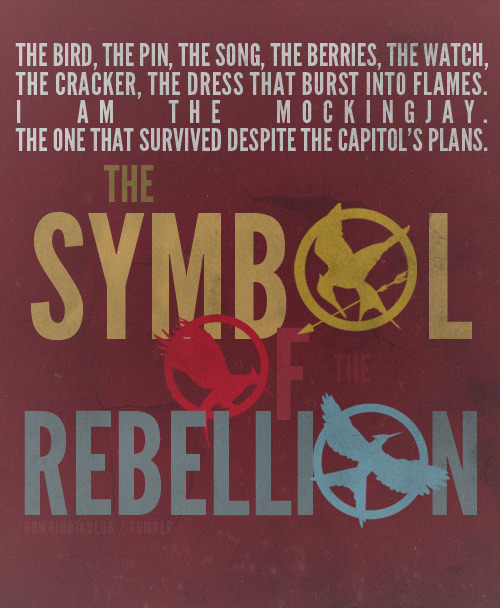
Bioethics makes an appearance in this novel, though not many take the time to think about its inclusion. The Capitol has many scientific advantages in this futuristic setting. They created the Jabberjay, a bird “that repeat[s] what [it] hear[s] people say, similarly to parrots “(Cook, Keller, & Myer 32). The Jabberjay was used as a spy to try and pick up on rebels’ plans to take down the Capitol. “The rebels caught on and started feeding the Jabberjays false information. That led authorities to abandon the Jabberjays in the wild, hoping they would die off” (Cook, Keller, & Myer 32). However, this plan went awry. The Jabberjays ended up mating with mockingbirds. Combining the talents of both birds, the Mockingjay (as their offspring are called) is able to listen to tunes and repeat them back. “The inability of the government to control these animals made them a symbol for the rebellion” (Cook, Keller, & Myer 32). Hence, why Katniss becomes Panem’s “Mockingjay.”

This can spark a debate in the real world. “Should hybrid species be regulated? What are the possible effects of hybrids mating with native species?” (Cook, Keller & Myer 35)


Source: tumblr.com
Discover more about this issue at Bioethics.net.


Source:

Cook, K., Keller, D., & Myers, A. (2014). BIOETHICS IN THE HUNGER GAMES. Science Teacher, 81(1), 31-37. Retrieved from http://navigator-clarion.passhe.edu/login url=http://search.ebscohost.com/ login.aspx?direct=true&db=a9h&AN=93387028&site=ehost-live&scope=site

The Capitol: Their Own Worst Enemy


The Capitol thought that by creating The Hunger Games, they were doing themselves a favor. Turns out, it was the exact opposite. Understanding their ways actually can be beneficial to someone who is against them. Katniss has proven this “by becoming adept at interpreting and using information and the media, Katniss not only survives, but also outwits the Gamemakers, undermines the power of the Capitol, and sparks a revolution” (Latham 34).


In The Hunger Games, the children do go to school, but what they learn about the history of their world and the information about its current state are, indeed, limited. “It seems unlikely that a Capitol-sanctioned curriculum would emphasize the development of information and media literacies, skills often associated with democracy and empowerment” (Latham 36). The Capitol ensures that it does not come right out and say how it functions, but “in Panem, as in all totalitarian societies, the government’s survival depends not only on its ability to impose punishment and enforce discipline, but also on its ability to manipulate media and control the flow of information” (Latham 35). Watching the Games is mandatory, and, by doing so, the viewers single out hints on how the Capitol runs. The Capitol believes no one can pick up on these mechanics because they do not outright profess them. That would, of course, be foolish—but, then again, so is teaching your restless citizens how to fight to the death. 


Katniss “develops knowledge and skills as a result of her preparation for and participation in the Games themselves“(Latham 36). There is training right before the actual Hunger Games so the Tributes stand a better chance at surviving for as long as possible. This is provided by the Capitol. Smooth. Not to mention the fact that Katniss certainly had an advantage going into this setting because of her skills as a hunter that she learned because the Capitol’s treatment of his District called for desperate measures (Latham 36).


Source: sailormoonnews.com


Source:

Latham, D., & Hollister, J. (2014). The Games People Play: Information and Media Literacies in the Hunger Games Trilogy. Children's Literature In Education, 45(1), 33-46. Retrieved from http://navigator-clarion.passhe.edu/loginurl=http://search.ebscohost.com/login.aspx?direct=true&db=a9h&AN=94081212&site=ehost-live&scope=site